Northumberland/Farne Islands – 07-10 Jul 2016

On Thursday of last week Helen and I travelled up to Northumberland for a long weekend. We love visiting the Farne Islands on the boat trips and walking along the beaches photographing the castles. I normally blog on the day of a birding trip, but we packed so much into our weekend that it has taken me two days to sufficiently recover and sort out my photos ready to update the blog. Increasing decrepitude is a terrible thing!

Thursday 07.07.16 – Farnes Sunset Cruise

We couldn’t leave Sheffield much before about half past two in the afternoon to drive the 180 miles or so to Seahouses and yet we had very much hoped to be able to join the 2-3 hour Serenity Sunset Cruise around the Farne Islands. (We had done this once before and it was fantastic). We hadn’t booked tickets in advance because we weren’t sure if we would get up there in time for the 7pm sailing, and the weather was pretty poor in any case, with lots of rain about.

The traffic was fairly light on the way North, and by the time we reached the Tyne Tunnel area we were feeling increasingly hopeful of at least arriving in time for the cruise. As we entered the tunnel the sky was still a bit grim and drizzly. But on emerging from the other end of the tunnel a couple of minutes later, however, the sun had miraculously appeared in the sky, as if by magic, and the whole evening was transformed!

By the time we were about ten minutes away from Seahouses we felt quite confident as there were still about twenty-five minutes to go before the boat was due to leave the harbour; it would be close, but we could make it. That’s when we got stuck on the B-road we were travelling on by a flock of about two hundred sheep! I was sure we’d had it by then, but we did manage to get away after a few more agonising minutes during which the car was being continually buffeted by large woolly sheep as they slowly passed us and ambled up the road, stopping to forage the hedgerows as they went! Grrr!

We made it onto the boat with about two minutes to spare! And what was really brilliant about it from our point of view was that, since the weather had only very recently improved, hardly any other people were on the boat with us. Last time it had been a bit crowded and it wasn’t always easy to take the photographs we wanted due to the sheer numbers of other keen photographers on board with us. This time we had no such worries and the weather had turned glorious – how lucky was that!

Over the next couple of hours we were thrilled to be so close to the many tens of thousands of seabirds which visit the Farne Islands every Summer to breed – near the famous Pinnacles at Staple Island we were literally within touching distance of the birds!
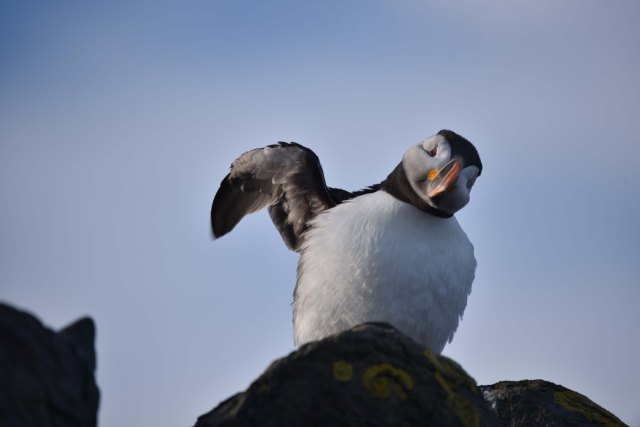
DSC_0811

This Puffin very kindly gave us directions back to Seahouses harbour!

By far the most abundant species which breeds on the Farnes is the Guillemot, but there are also huge numbers of Puffin (37,000 pairs), Shag, Razorbill, Kittiwake, Arctic Tern and Sandwich Tern. We also saw a good few Gannets flying overhead, presumably on their way back towards the Bass Rock further up the coast in Scotland. There were also lots of female Eider Ducks present with their young staying close by their sides in the choppy sea, and terns diving to catch fish just by the boat. Numerous Puffins, Razorbills and Guillemots darted overhead, returning to their young with mouthfulls of juicy sand-eels.

Part of the tour around the Islands takes visitors past Longstone Lighthouse, made famous by the daring rescue carried out by Grace Darling and her father William, (the then lighthouse-keeper at Longstone), in 1838 of a number of survivors from the wrecked steamship Forfarshire which ran aground in the Farnes after one of its boilers exploded in atrocious weather. The lighthouse still operates to this day (powered by solar power nowadays), but is no longer manned. As we sailed past the island, we were pleasantly surprised to see a flock of Turnstones in full breeding plumage scrambling around the rocks at the foot of the famous building.
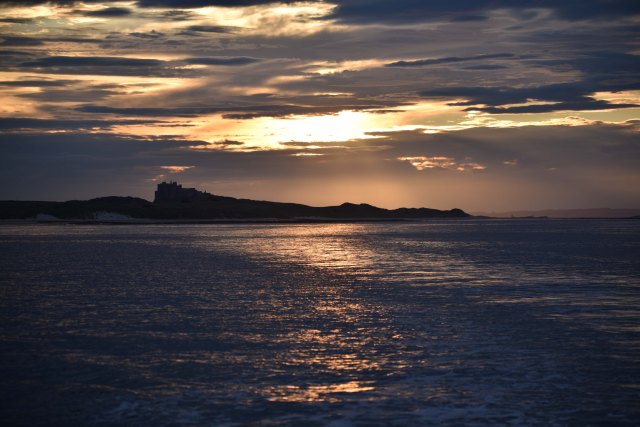
DSC_1506

Bamburgh Castle at sunset

As we returned towards Seahouse harbour it had begun to become rather chilly, but the sunset was fabulous and we took several photos of Bamburgh Castle looking very mysterious and romantic in the dying sunlight.

Both Helen and I would do the Farnes Sunset Cruise again in a heartbeat!

Friday 08.07.16 and Saturday 09.07.16 – Lindisfarne, Embleton, Howick & Bamburgh

Friday & Saturday weren’t about birding – it was castles and beaches (and pubs!). However, during the course of the two days we did spot a number of birds, naturally, including some Stonechats at Howick and Sandwich Terns fishing in the sea near Bamburgh Castle.

Sunday 09.07.16 – Staple Island Cruise

We were to be leaving for home again today, and we hadn’t as yet set foot on any of the Farne Islands so far this trip. We have previously been on Inner Farne a good few times and Staple Island once before. These are the only two Farne Islands which the public are allowed to land on. All of the islands (28 in total depending on the tides) are closely controlled by the National Trust whose wardens decide when it is safe for the public to land.

Inner Farne is the most popular and most visited island by far, with wooden walkways to allow the public to safely walk around the island. Staple Island is very different – it is more for serious bird-photographers and ornithologists. There are no walkways on Staple – just bare rock – but visitors have much more freedom to roam and can get really close to the birds – Puffins in particular. As a bird photographer, Staple Island is simply more exciting than Inner Farne, being wilder and less controlled.

One problem with Staple Island visits though, is that landing is much trickier there due to regular sea swells by the landing jetty. It’s often not possible for the boats to safely land visitors there and so its always a bit of a gamble booking for Staple Island.

Helen and I were willing to gamble on Staple Island being accessible today though, as the sea was quite calm. It was rather dull and overcast as we arrived at the harbour, however, and very unlike the beautiful evening we’d enjoyed on Thursday.

We bought our boat tickets, paid the National Trust’s landing fees and made our way to the end of the pier to board ‘Glad Tidings’ – our vessel for the 2-3 hour cruise. No sooner had we set-off when the heavens opened and it rained torrentially. It was quite miserable on the open deck (there being no cover whatsoever for passengers on this boat) and we were soon as wet as could be! There was no way we could get our cameras out in the downpour, and visibility was pretty poor anyway.

We did much of the same guided-tour today as we had on Thursday evening in the glorious sunshine. Today everyone on the boat was hunkered-down against the weather; no-one was taking any photos at all in the pouring rain. Most people weren’t even able to see past gaping anorak hoods or umbrellas!

Eventually, and as we closed-in on Staple Island, the rain began to abate and we could finally begin to watch the birds. We docked at Staple Island with no trouble at all and everyone on the boat began to stand-up in preparation for climbing onto the island. Helen and I were certainly becoming excited, wet bottoms notwithstanding!

That was when the National Trust warden delivered the bombshell – the rain had been so severe and the rocks had become so slippery that they wouldn’t allow us to land! Apparently, another visitor in recent days had slipped and seriously injured themselves on a similarly wet day, and the NT wardens weren’t taking any chances. What a blow!

Things were actually made slightly worse by the fact that a previous boatload of visitors, who had reached Staple Island before the downpour, had been allowed to land and they were now shephered onto our boat for the trip back to Seahouses – a double whammy!
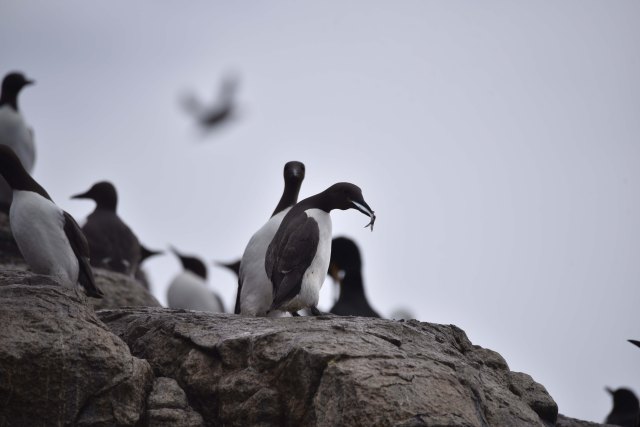
DSC_2109

A Guillemot with lunch!

All Helen and I could do was snap a few quick shots of the seabirds on the rocks by the jetty before we chugged off back to Seahouses. As we passed Inner Farne the sun was shining beautifully. If only we had elected to go there again instead today! Grrr!

A huge disappointment for us then – better luck next time, we hope!

Posted in Uncategorized | 1 Comment

North Cave – 05 Jul 2016

It’s been nearly a fortnight since I was last able to get out birding. However, I was able to fit in a quick visit to North Cave today on what was also about the first dry, sunny day we’ve had in a couple of weeks too! The general consensus is that this will have been a poor Summer, weather-wise at least.

I wanted to walk down Dryham Lane to look for waders on the Ings. A Wood Sandpiper was recorded here yesterday and I would really like to see one of those, having narrowly missed one on a couple of previous occasions.

The water level was good today and the water margins were absolutely teeming with birds; a huge number of juvenile Black Headed Gulls were there, some begging attendant parents for food whilst others appeared to be feeding more independently now. There were also large numbers of Feral Pigeons on the islands, a few Avocet and a good number of Lapwings around Dryham Ings.

It was very difficult to try to spot a bird as small as a Wood Sandpiper amongst all the other birds present, and unfortunately I was unable to locate the bird, (always assuming that it was still there, of course!) I did, however, manage to see some Black Tailed Godwits in full Summer, breeding plumage and a lone Redshank which was feeding alongside them. A few Cormorants were an unexpected surprise, basking in the sunshine.

A rather scrawny Dunnock posed for me on a fence as I walked back towards the car. I couldn’t quite tell if it was a moulting adult or a recent fledgeling. It’s always nice to see any bird, however.

A very brief visit then, but it’s always nice to get out for the walk, at least.

Posted in Uncategorized | Leave a comment

Gibraltar Point – 24 Jun 2016

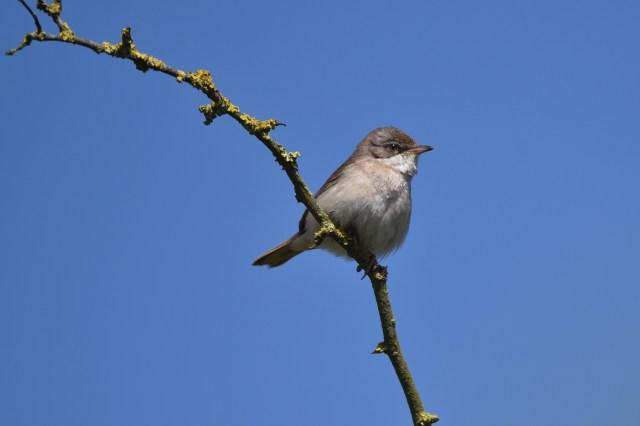
173 – Lesser Whitethroat

Another day, another new bird…this time a beautiful Lesser Whitethroat.

Lesser Whitethroat

Lesser Whitethroat

I went to a brand new location today – Gibraltar Point NNR near Skegness in Lincolnshire.

It was a bright day when I arrived at the reserve. A light breeze was blowing in off the Wash, but it wasn’t strong enough to cause any concern. I had wanted to visit Gibraltar Point for some time, and with several sightings of no-less than a rare Caspian Tern on Tennyson’s Sands in recent days, I decided today was the day I would try my luck there.

I parked at the Beach Car Park which is a little bit along the road from the brand new Visitor’s Centre and main car-parking area. The new centre was built to replace an old one that had been destroyed in bad weather a couple of years back. Although I decided not to go inside it today, I could see from a distance that it looked a fabulous building, and definitely somewhere to visit on a future occasion.

I visited each of the hides which overlook Tennyson’s Sands, and although I didn’t see terns of any kind, let alone a Caspian one, there were quite a number of other birds around. A good many avocets were sifting their way through the mud in the shallows, whilst a few others sat tightly on nests, a large group of Canada Geese were having a snooze on one of the islands, and various other birds including Shelduck, Reed Warbler and Little Egret kept me occupied as they zoomed back and forth around the lagoon in front of me.

Next I visited the Mere and Fenland Lagoon hides. A solitary, distant Redshank and a roosting Little Egret were all I could see on Fenland Lagoon, unfortunately, but I could see great potential there for passage waders come the Autumn, given its proximity to the Wash.

As I continued walking along the path towards the sand-dunes, I could hear a great assortment of small warbler-type birds, but as usual they were proving nigh-on impossible to spot.

I walked all the way down to the shoreline and stayed there a while to enjoy views of the ‘swarm’ of offshore wind-turbines that have been installed on the Wash.

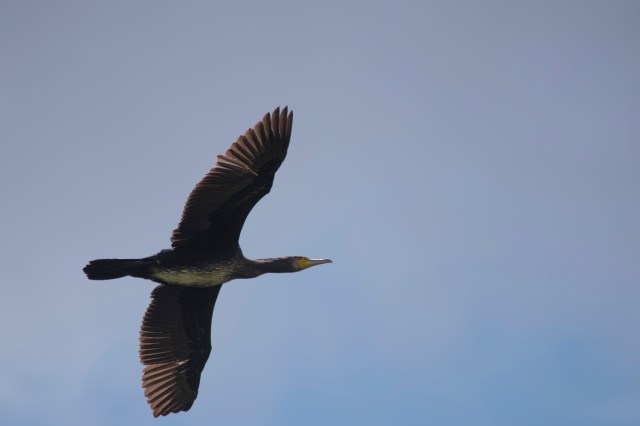
On my way back along the path I had great views of a Cormorant that was flying back and forth overhead, but undoubtedly my best shot of the day was the one, single frame I was able to capture of a cracking Lesser Whitethroat before it disappeared back into the safety of the impenetrable undergrowth as quickly as it had appeared! If I’d blinked I would have missed it altogether! I was particularly pleased to see the bird as I didn’t already have an image of a Lesser Whitethroat.

DSC_0197b

A Cormorant flies overhead

So, I was lucky enough to get a new bird today – just not the one I had set-out hoping to see. Birding is never predictable, but then no-one in their right mind would want it to be!

Posted in Uncategorized | Leave a comment

Blacktoft Sands – 23 Jun 2016

On the day of the EU Referendum I decided to escape to Blacktoft Sands to take my mind of the issues involved; frankly I’ll be glad not to hear about it any more once it’s all over and done with!

It was a warm day, if a bit cloudy at Blacktoft. I hadn’t been there in about a month and I was not really surprised to see how much everything had grown. The reeds along the trails had grown taller than me by now, so although I could hear a few warblers singing in amongst all the vegetation, there was nothing to see of them.

After a quick visit to the Reception hide where I snapped a few shots of a Marsh Harrier just outside the window, I made my way towards Marshlands Hide where I understood there were some Spotted Redshanks present.

Sure enough, there were eight full Summer-plumage Spotted Redshanks visible from the hide. Unfortunately, they were about as far away as it was possible for them to be whilst still remaining visible from my vantage point, so the images I took aren’t brilliant, to say the least.

Other birds present from the hide included three Little Egrets, a Heron and a large flock of Teals, (a bird which I haven’t seen for a while). The cacophonous Black Headed Gulls have finished breeding here now and the Marshlands lagoon is peaceful once more!

I decided against doing the long walk up to Ousefleet Hide today. It’s usually the best place at Blacktoft for seeing waders close-up, but the sky had begun to steadily darken and I didn’t want to get caught-out in any downpour that might be about to happen!

Next I visited Xerox Hide and then Singleton Hide, at the Eastern end of the reserve. Whilst there wasn’t much to see from Xerox today, there was a lot of Marsh Harrier activity going on at Singleton (as usual). A beautiful male harrier was constantly flying low over the reedbed outside the hide looking for prey items. I got a few good shots of one of them which came particularly close-in to the hide. He eventually caught something I couldn’t identify and flew off with it somewhere out of sight.

I did manage to take a few photos of a robin and then a warbler in a Willow Tree as I returned along the path towards the car park. It was either a Chiffchaff or a Reed Warbler, but as it didn’t make a single sound I couldn’t tell which it was. Grrr!

By this time it had reached 4pm and I wanted to get home – back to the Referendum debate!!

Posted in Uncategorized | Leave a comment

Bempton Cliffs – 18 Jun 2016

Wow – what a day! Helen and I went to Bempton Cliffs today and we got some great pics between us.

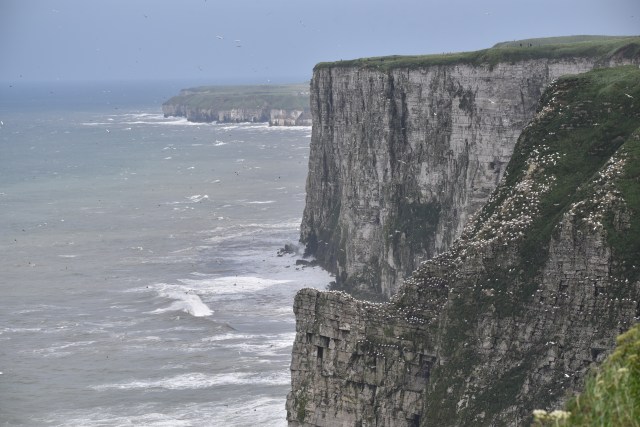
Bempton Cliffs

The Rugged Bempton Cliffs looking South towards Flamborough Head

We’d begun the day by looking at the weather forecast for several of our favourite reserves. As Bempton was the only one that was promised good weather today that was where we decided to go. As it turned out it was a bit breezy atop the cliffs, but then it almost always is at Bempton! This didn’t cause us much concern, however, and actually helped because it meant many of the seabirds we had gone to photograph were struggling to make headway flying into the wind, and it’s obviously much easier to take pictures of birds that are nearly static!

By the time we arrived around 1pm the reserve was bustling with visitors. On busy days like today, volunteers with walkie-talkies man the car-park, and guide drivers to spaces. A nice lady very helpfully pointed us in the direction of the only remaining space in the main parking area! (There is, however, a large overflow car-park in a field adjacent to the site which is regularly in use during the Summer months).

Looking back through my blog posts I note that our last visit to Bempton was on a bitterly cold day back in March (the 20th). Today was a much more pleasant experience, not only because it was much warmer, but also because there were far, far more birds present today with it currently being the height of the breeding season.

At the bottom of the path that leads down to the cliffs from the Visitor’s Centre, we chose to turn right today and head down towards Roll-Up and the Staple Neuk observation points.

All along the cliffs, as is usual during the breeding season at Bempton, there were tens of thousands of seabirds. The Gannets look awesome, flying really close to the edge of the cliffs and only a few short feet away from us. With their two metre wingspans they are fantastic to watch as they zoom back and forth riding the thermals; they are truly huge birds! Helen and I always find it hard to stop snapping away at them whenever we visit Bempton. We always come home with literally hundreds of Gannet pictures to sort out!

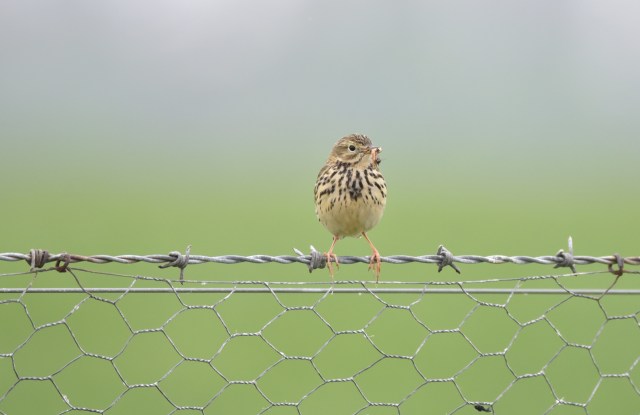
There were all the other usual seabirds in evidence today as well: Kittiwakes, Puffins, Razorbills and Guillemots, along with smaller numbers of Herring Gulls, Rock Doves and Jackdaws. In the shrubbery bordering the path we also spied several Pied Wagtails and a lovely Meadow Pipit today.

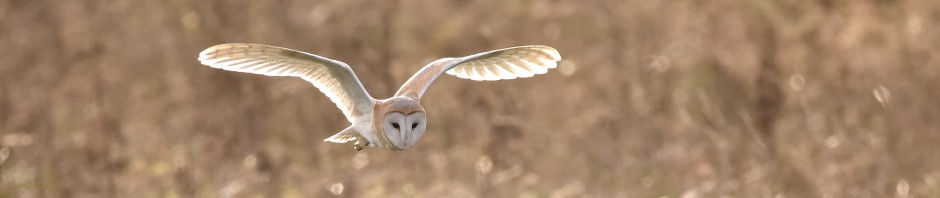
In addition to all the seabirds we saw, we also had good sightings of a couple of rather unexpected birds along the cliffs today: a Kestrel and a Barn Owl. There is an owl box a couple of hundred yards from the Visitor’s Centre, and this was obviously in use by the owl we watched quartering the fields nearby. We observed the bird for a good twenty minutes during which time we were able to get a number of good photographs, including some with the sea in the background, which seems a bit unusual in itself.

Bempton is a fabulous (if stinky!!) reserve to visit. I’m already looking forward to my next visit there.

Posted in Uncategorized | Leave a comment

Old Moor – 11 Jun 2016

I went to Old Moor today for the first time in over two and a half weeks, and a full week since my last birding trip anywhere else.

I was actually in two minds about going to Old Moor – because there’s a very rare MEGA bird there at the moment. A Little Bittern, which was present around the same time last year, has returned and has being ‘wowing’ the crowds at Old Moor once again. I read about it on the daily blog whilst in Scotland last week and had been wanting to try to go all week since I got back.

However, for one reason or another, today – a Saturday, was my first opportunity to go. I knew it had been ‘standing room only’ in the Bittern Hide last weekend, and rather guessed it would be the same again today. That coupled with the fact that it was a very dull, damp and humid day didn’t bode well from the start!

When I arrived at Old Moor I was rather surprised to find that the car park wasn’t any busier than usual. Perhaps it wouldn’t be mobbed with birders today after all?

I made my way round to the Bittern Hide, outside of which were various groups of people scouring the skies in hope of seeing the Little Bittern. When I opened the door and went inside it was just as I had feared – ‘standing room only’ once again. Hardly surprising though given that both the ‘ordinary’ Bittern and the Little Bittern have been showing very well, and regularly all week, including earlier-on today.

DSC_7906b

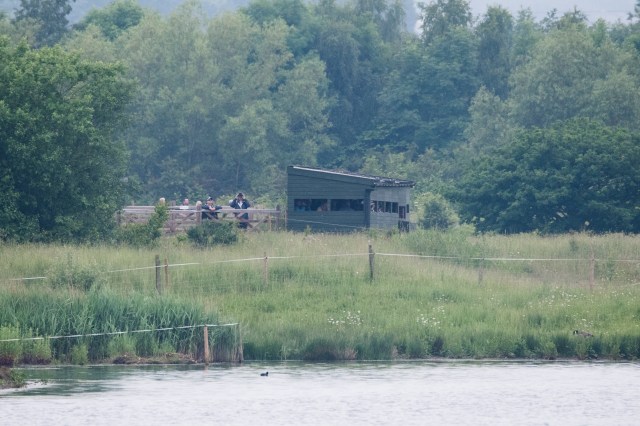
A very busy Bittern Hide, as seen from the rather more deserted Wader Scrape Hide.

I decided not to stay; hides can be creaky, damp and occasionally unpleasant places to be in, but this one was full of people and there was nowhere for me to sit, so I decided to depart. Perhaps, if the bird is still there, I might try again one week-day next week.

I visited the Family Hide for a few minutes where I watched a pair of Oystercatchers with a lone chick between them, and then walked up Green Lane visiting all the hides up there. There wasn’t a lot showing today, perhaps due to the cloying, damp atmosphere and uniform, grey sky; it was very still without a breath of a breeze at all.

I did see lots of Black Headed Gull chicks at various stages of development from the Wader Scrape, and then I watched a rather sad episode unfold from Wath Ings Hide: A female Pochard was swimming around with her brood of seven or eight chicks in tow. I noticed that one chick was quite a way distant from the rest and was rapidly swimming towards the group to rejoin them for safety. When it got close to the other chicks, the female Pochard drove it away. The chick tried several times to join up with the others, only to be driven-off each time.

It was only then that it dawned on me that the solitary chick wasn’t marked quite the same as the others – it wasn’t one of hers at all! It was a Mallard chick which had obviously become separated from its own family. The female Pochard was having none of it, with enough chicks of her own to look after. The poor Mallard chick seemed quite distressed, and no wonder! With so many predators around the site, its chances of survival wouldn’t be great if it wasn’t quickly reunited with its own family. I scanned the area of water I could see from the hide, but sadly there was no sign of any Mallards with chicks. I left the hide hoping that the chick would be ok, somehow…

On the way back down Green Lane I managed to capture one, single image of a Sedge Warbler darting through the undergrowth. The only other things of note that I photographed today were some of the irises along the lane. They are looking glorious now, and they, at least, tend not to fly away, thank goodness!

Posted in Uncategorized | Leave a comment

Loch of Kinnordy – 04 Jun 2016

I went up to the Loch of Kinnordy for an hour this afternoon. It was a sunny day and there were lots of birds singing in the trees on the reserve. I first went into Gullery Hide where I watched a Roe Deer browsing the fresh, green reeds growing just outside the hide. It was keeping a wary eye on the hide in case of danger, and spent a good fifteen minutes in plain view before it finally disappeared from sight into the undergrowth.

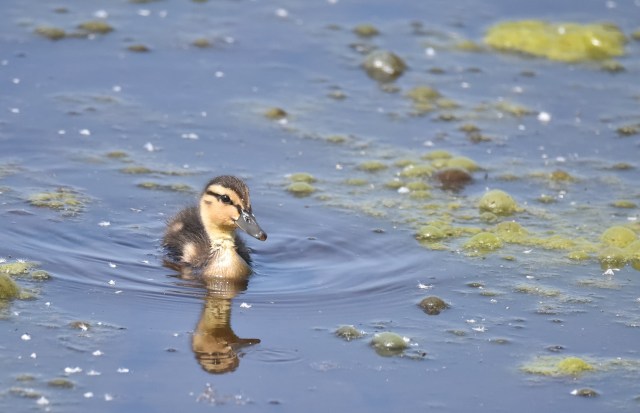
There was a female Mallard with a troupe of recently-hatched ducklings dabbling-about in the weeds in front of me. The ducklings were innocently exploring everything they could find under their mother’s watchful eye. Other than that a few Black-Headed Gulls were nesting on the island in front of me and the odd Lapwing flew lazy circles overhead.

image

A cute Mallard duckling

As I watched the loch, I once more became aware of a fishing Osprey hovering high above the water. (That’s three consecutive visits to Kinnordy during which I’ve sighted Ospreys.) The raptor didn’t take long to catch a fish on this occasion. Last week the bird I photographed had caught a pike; today’s catch looked like a trout from my somewhat distant vantage-point. I couldn’t, of course, be sure if it was the exact same bird, but given that it took its catch to the same perch as did the one I watched last week, I rather suspect it was the same Osprey.

Whilst the Osprey was busy shredding and eating its fish supper, further up the loch a male Marsh Harrier appeared and flew low over the reedbeds, also on the lookout for something to prey on. This bird was not having the same degree of success as the Osprey as it was constantly being harried by a pair of gulls. It eventually gave up trying to hunt and dropped into the reeds out of sight.

I next walked up to the Swamp Hide to the West of the reserve. Here I watched a gaggle of about thirty Canada Geese swimming in formation on the loch, and a solitary Shelduck which flew over the loch some distance from me. The willow trees outside the hide were alive with small birds singing away. I could hear and identify both Willow and Sedge Warblers from their distinctive songs, but couldn’t see one single bird amongst all the dense foliage on the trees.

I made my way back to the car, looking forward to my next visit to Kinnordy, whenever that might be.

Posted in Uncategorized | Leave a comment

Bridge of Dun & Glen Doll – 01 Jun 2016

I had two short birding experiences, on a very hot and sunny day today – Bridge of Dun near Montrose Basin in the morning and up my favourite Scottish Glen – Glen Doll this afternoon.

I had gone specifically to visit ‘The Lurgies’ which is at the Western end of the Montrose Basin. I’ve had some great pics there in the past, including my first ever Osprey. However, on arrival I discovered that it was high-tide and the mudflats were completely submerged. Not to be put off, though, I went about two miles further to the bridge over the River Esk at Bridge of Dun.

The River is about fifty feet wide here and I was able to stand on purpose-built viewing parapets on either side of the bridge. On the river banks either side of the river there were dozens of Sand Martin nesting-holes. Parent birds were constantly zooming around, in and out of the holes with a constant supply of insects, presumably to feed young inside their nest burrows. It is extremely hard to photograph such fast-moving birds, but over the course of half an hour or so I was able to capture several reasonably sharp shots.

During the time I was on the bridge a pair of Buzzards appeared above me and so I had a new ‘target of opportunity’ to photograph. The birds were directly above me in the pure blue sky and some of my resulting photos look pretty good, if I say so myself.

By the time I left to return home I’d taken a good many photographs which also included Pied Wagtails, a Sedge Warbler and a Jackdaw which gave me quite a close fly-by.

Later in the day, my mother and I decided to take a drive up Glen Clova to the much smaller Glen Doll which lies at the head of the glen. This is a spectacular area with rugged mountains all around, acres of pine forest and a beautiful, fast-flowing river running through it. I had decided to take my camera with me just in case something exciting popped-up in front of me – and that’s precisely what happened!

About a mile before the car-park/picnic area, I suddenly stopped the car on the single-track road I was driving along as I’d spotted a Wheatear perching on a rock just a few feet from the road. The bird very obligingly allowed me to get out of the car, fetch my camera from the boot and take about twenty photographs before it finally flew away. And fortunately, no other vehicles came along the road whilst I was snapping away, as my car was completely blocking the road! Thanks Wheatear!

Another great Birding day!

Posted in Uncategorized | Leave a comment

Fowlsheugh – 29 May 2016

172 – Tree Pipit

Well, following on from my last post, it was Fowlsheugh that I visited next during my current Scottish holiday.

It was a glorious sunny day when I left Forfar to drive the forty or so miles up to Fowlsheugh. Unfortunately, a sea-haar had rolled-in by the time I arrived at the reserve. It was still pleasant and warm, however, despite being a bit foggy.

Tree Pipit

A Tree Pipit with its lunch

As I left the car I could see a number of small birds in the gorse bushes near the car-park. A beautiful Pied Wagtail sitting on a stone wall gave me my first photo-op of the day.

When I had climbed the bank up to the cliffs I was immediately struck by the strong smell of bird-poo – yeuch! It was just like at Bempton Cliffs or the Farne Islands; a smell that I hadn’t experienced for a while, and wasn’t entirely ready to smell again. However, they do say that you have to suffer for your art!

The cliffs at Fowlsheugh were absolutely packed today – not with humans, but seabirds. There were: Guillemots, Razorbills, Kittiwakes, Herring Gulls and Fulmars galore. I also saw a couple of Puffins, which is always a treat.

I also saw both Rock and Tree Pipits, and a Linnet on the top of a gorse bush.

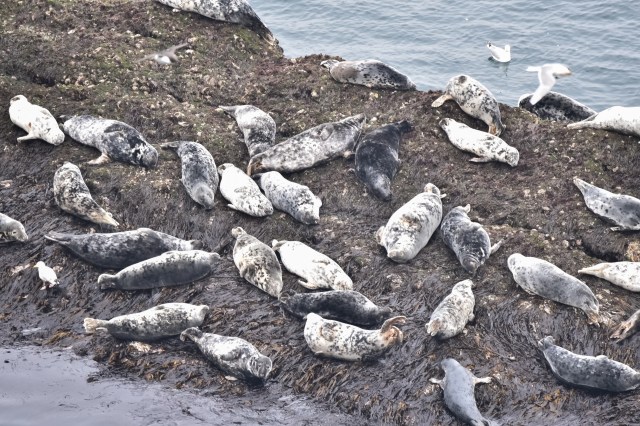
What I hadn’t expected to see was a large group of seals hauled-out on the rocks below me. Next to them were a group of Eider Ducks swimming in the sea. The ducks were so distant, however, that I didn’t even see them until I inspected the photos later on at home.

image

By the time I got back to the car I had walked 4.54 miles according to the health app on my iPhone, and although tired, I felt really pleased with my photos from the day.

Posted in Uncategorized | Leave a comment

Loch of Kinnordy – 28 May 2016

I’m up in Scotland at the moment, visiting my mum in Forfar. When I’m up here I always try to fit in some Birding at the local RSPB reserves. It was a lovely afternoon today so I decided to visit the reserve at the Loch of Kinnordy near Kirriemuir, about six miles away from Forfar. I’ve been here a few times now, and last time I visited I got some great pictures of an Osprey flying over the loch.

The Loch itself was quiet today apart from a few Mute Swans, a somewhat unexpected pair of Wigeon, several Lapwings and a group of about forty Greylag Geese visible from the Marsh Hide. The trees around the reserve were full of singing birds – most easily identifiable were Willow Warblers, which sounded as though they were present in almost every single tree on the reserve! In all the time I was there today, however, I only managed to spot a single one; the volume of foliage on the trees by this time of year makes it extremely difficult to see any birds at all, let alone tiny ones like warblers. I did get a few shots of a Wren in a tree by the Gull Hide, but even that was largely obscured.

As I sat in East Hide, trying to spot small birds in the reeds that I could otherwise only hear, I suddenly became aware of an Osprey flying overhead, clearly on the lookout for a fish in the water below. As I watched the bird, it hovered for a bit, eyes scanning the surface of the loch, and suddenly plummeted down into the water. A few seconds later and the bird managed to get aloft again, carrying a medium-sized pike in its talons. The Osprey was struggling to carry its catch, which looked to weigh around two pounds, but managed to carry it to the top of a perch on the far side of the loch from where I was watching spellbound in the hide. Thereupon the Osprey proceeded to eat its meal.

It was great to see an Osprey again, and particularly one catching a fish. That’s two consecutive visits to Kinnordy when I’ve seen an Osprey. I’ve also seen one on rwo separate occasions at Montrose Basin which is about twenty miles from here. The Loch of the Lowes is another well-known Osprey breeding site. It also lies around twenty to twenty-five miles from here. Perhaps I should consider paying a visit there in the next few days? The other alternative visit I have in mind is to Fowlsheugh RSPB up near Stonehaven, which is a fabulous ‘seabird city’ with easy access to cliffs swarming with Guillemots, Razorbills, Kittiwakes, Fulmars and Puffins amongst others. So much choice….!

Posted in Uncategorized | Leave a comment